Bracing for Impact: Is the Grand Traverse region ready for big data centers?
November 2026
Is the Grand Traverse region ready for big data centers?
From an environmental, municipal and cultural standpoint, the answer to that question is very much up in the air. Multiple townships have enacted or are considering temporary moratoriums on data centers as various concerns about these power-hungry facilities circulate on social and traditional media.
But from a simple energy supply standpoint, the answer is yes. All three of the region’s major power suppliers – Consumers Energy, Cherryland Electric Cooperative and Traverse City Light & Power – say the grid is capable and ready to provide significant electricity to large data centers, should they be built here.
Like municipalities, these utilities are taking various steps to prepare for data centers, including actions to protect their other customers from rate impacts, energy shortages or other unintended consequences.
The lay of the land
Addresses in Michigan have a predetermined, inflexible electric service provider (if you live at or want to run power to a Consumers address, you can’t decide to use Cherryland instead). While there is some overlap in infrastructure and facilities, most of the utilities have their own poles, lines, transformers and other necessary transmission assets.
“The grid,” therefore, is made up of thousands of miles of line and supporting infrastructure that’s owned and maintained by separate entities, all of which are subject to various local, state and federal regulations.
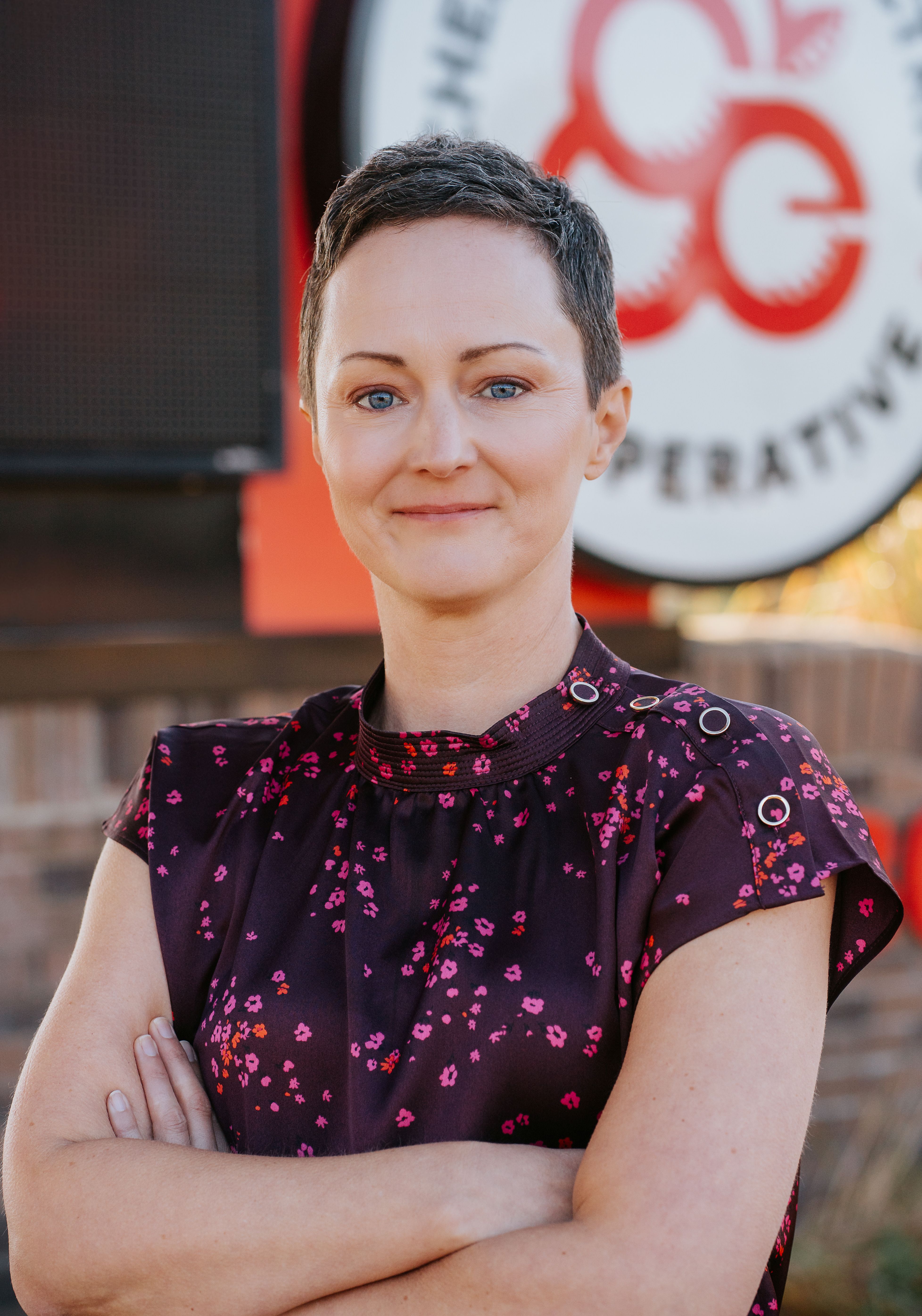 Rachel Johnson
Some utilities (like Consumers) generate their own power using a variety of fossil fuels and renewable sources. Others (like Cherryland and TCLP) purchase and import power from elsewhere or have partial ownership interests in various generation facilities.
Power is readily transported and stored around the state, meaning the electricity that comes from an outlet in Kingsley may have been generated hundreds of miles away.
Though the recent talk of data centers is largely focused on those huge, power-hungry mega facilities (often called “hyperscale” data centers), several much smaller data centers already exist in the region.
Good to go, pay to play
Consumers, Cherryland and TCLP all say there would be no problem providing even large-scale data centers in the Grand Traverse region with electricity, though the developers of those data centers would be on the hook for certain costs.
“If they want the power, it’s there,” Consumers Energy Media Relations Specialist Matt Johnson said.
Consumers, which covers a large swath of the Grand Traverse region, recently announced it will more than double its system capacity from around 14 gigawatts to 34 gigawatts by 2040. They’ll accomplish this by bringing on a variety of new fossil fuel and renewable generation facilities.
“But prior to any of that work happening, we absolutely have ample energy supply to meet the demand today,” Johnson said.
Indeed, Johnson says, Consumers is required by law to provide power to any customer that requests it. Luckily, that’s nothing new.
“We’re legally obligated to serve any customer that decides to locate (in our service area),” he said. “But we did this with the auto industry, and manufacturing, and we’ve been doing it for 140 years. We’ve always had to find a way.”
For TCLP, which primarily imports power, and Cherryland, which imports all of its power, buying and supplying more to a large data center wouldn’t be a problem, leaders there said.
But that doesn’t mean that a data center developer can just build, plug into the system and be done with it. Utilities are taking steps to ensure that they cover costs and
 Matt Johnson
don’t impact other customers.
Consumers, for example, recently got approval from the Michigan Public Service Commission (MPSC) to create a specialized large load tariff amendment for customers using more than 100 megawatts of electricity. It requires them to cover the costs of their own dedicated infrastructure (poles, lines, substations) and any additional generation resources.
It also requires large power users to pay for 80% of their expected demand, regardless if it's used, to ensure that other customers aren’t footing the bill of additional power generation.
“We fought for those protections because we want to make it clear to our customers and to the state that data centers would not raise costs for residential customers,” Johnson said. “These are some of the strictest standards in the entire country, actually, for regulating data centers.”
Cherryland recently adopted a policy for customers over 10 megawatts that is relatively similar. It requires a customer looking to use that much energy to cover all costs associated with engineering studies and infrastructure upgrades up front and sign long-term contracts with exit penalties.
“They have to cover 100% of the upgrade costs, not just to the distribution system, but also the substations and transmission system,” Cherryland CEO Rachel Johnson said. “And it has to be done up front so that if they want to connect, they cover 100% of the physical things we would have to build to connect them and the work that goes into figuring out what they need.”
It also requires a hefty non-refundable application fee.
“This space right now is a little bit like the Wild West, and it’s a bit speculative, so we have non-refundable application fees that are large enough that you’re not going to just do it,” Johnson said. “You want your employees spending time on real things that serve and benefit the community and members.”
All of this proactive, protective work is incumbent upon these utilities, whether private (Consumers), member-owned cooperative (Cherryland) or public (TCLP).
“Utilities have to really be prepared so that if that customer comes knocking, they can come from a position of negotiating strength to make sure they have negotiated as much of that benefit back to the customers they serve,” Cherryland’s Johnson said.
TCLP already has similar policies that require new large customers to cover the costs of connecting and serving them and is considering additional rules.
The upside to all of this is that data center developers might end up improving the grid across the board by virtue of having to pay for it.
“The fascinating thing to me is you are seeing perhaps a once-in-a-generation investment of private capital into electric infrastructure in a way we've never seen, and that … can improve service and reliability,” Cherryland’s Johnson says. “It doesn't have to all be bad.”
Will they come?
So, will large-scale data centers ever come here? While it’s obviously not up to the power companies, leaders there have thoughts about the region’s appeal for developers.
 Brandie Ekren
Consumers reported no interest from developers of very large data centers in the region. Cherryland reported no interest in data centers of any size. TCLP has had informal inquiries for centers up to 50 megawatts, a size that’s relatively big, but still much smaller than the “hyperscale” facilities that are capturing the nation’s attention.
Cherryland’s Johnson believes that while hyperscale centers could indeed be built here if developers are willing to spend the money on required upgrades, it probably makes more sense for them to locate in more heavily populated areas that already have more robust infrastructure.
“I have not personally heard from anyone interested in putting a hyperscale data center up here, and that doesn't surprise me. If I’m in their shoes, I want huge transmission systems where I hope to connect, and that’s not Northwest Michigan,” she said. “In general, if I’m looking at it purely from an electric utility perspective, I would locate in high-speed transmission corridors, and you’re already seeing that. They’re looking where infrastructure already exists … and they can scale up fastest.”
TCLP Executive Director Brandie Ekren tends to agree.
“You want to invest somewhere that is as site-ready as possible. It’s not impossible to build one up here, but it would require (a lot of line upgrades),” she said. “If you start getting into those hyperscalers, you’d have to build larger transmission systems. Those are more built out downstate than they are up north (so the biggest data centers) are probably going to be downstate first.”
Still, Johnson and Ekren say the region could indeed become attractive for smaller or mid-size data centers.
“With our fiber network, cool climate and low risk from natural disasters, our region is a strong fit for mid-size data centers, especially those designed to minimize water use,” Ekren said.
Johnson says she believes where the modern data processing-based economy is going, "you'll have these large hyperscalers wherever they make sense, but then you're going to have to become latency-based, smaller cloud computing facilities might be spread throughout. Something like that could certainly make sense somewhere here, and we already have that here.”
Utilities are watching carefully as the data center debate plays out in local townships and other municipalities.
“Data centers can bring investment, tax base and growth that makes clean energy more affordable for everyone. But they also raise legitimate concerns about water, noise, land use and who pays for grid upgrades,” Ekren said. “Communities in our region taking time to consider what works for them is a thoughtful approach, and TCLP supports that kind of careful, local decision-making.”
Ekren says that the right projects for northern Michigan would be sized to what its system can support, use cooling systems that minimize water use, and pay their own way.
“Projects that can reduce their power use during peak times or include battery storage could even strengthen the grid,” she said.