Canary in the Tool Shop: What America's tool and die decline means for efforts to reshore manufacturing
September 2026
A canary in the coal mine.
That’s how some experts see the domestic tool and die industry, a quiet but crucial backbone to the American manufacturing economy. Conventional wisdom says the tool and die sector in the United States is dying, with businesses closing their doors, the workforce aging out, and too few young people coming in to take up the mantle. It’s a status quo that has some manufacturing leaders sounding the alarm bells, insisting that saving tool and die is tantamount to saving American manufacturing, period.
Erin Hoffmann, CEO of the Grand Rapids-based Tier 1 supplier ArtiFlex Manufacturing, is one of the state’s loudest voices on that front, advocating for what he describes as “a comprehensive ‘restore the health of the tool and die industry’ campaign.” ArtiFlex, he says, has “created a document that outlines what needs to be done” to save Michigan’s tool and die industry.
Hoffmann is starting to have conversations with industry colleagues, state and federal policymakers, and other stakeholders in hopes of planting those seeds.
Last August, Hoffmann brought those talking points to Traverse City as part of ReShore, a now-annual event co-hosted by Traverse Connect and MichAuto that convenes industry leaders, innovators and policymakers for discussions about the future of advanced manufacturing, mobility and economic growth in Michigan. Sitting on a panel focused on reshoring Michigan’s manufacturing competitiveness, Hoffmann used the opportunity to highlight the state’s slide from tool and die powerhouse to relative has-been.
The tool and die apex
“Most of the tooling in this country – 80 to 90% of it – was built for the automotive industry,” Hoffmann told the TCBN. “Automotive has been the biggest buyer of stamping dies, molds and high-pressure die cast dies, and those are the three primary types of tools.”
While other industries – agriculture, defense, heavy-duty trucking – have leaned heavily upon tool and die shops, too, the fact that most of the work was being done for auto companies meant Michigan was historically a powerful player in the tool and die world. As the auto industry underwent meteoric growth between the 1960s and the turn of the millennium, Hoffmann says it made for a consistently “healthy” era for tool and die.
“Maybe a tool shop had 30 to 60 employees, and maybe we'll call it $5 to $15 million in revenue, and there were a lot of companies like that,” Hoffmann said. “Each company would specialize in a particular type of tooling, and those companies could thrive because their repeat customers valued their capabilities and their know-how. Those companies also tended to have good, strong apprenticeship programs, so they were constantly increasing the skills in their workforce and adding to their workforce.”
The tool and die industry, by designing and building the precision dies, molds, jigs, fixtures and machine tools necessary for all forms of mass production, in turn played a crucial role in propelling American manufacturing forward.
Cracks in the foundation
Now that period of relative prosperity is in the rearview mirror. According to Scott Bedow, a Wisconsin-based manufacturing manager and podcaster who has written extensively about the decline of tool and die in America, the sector is at real risk of becoming “a permanently hollowed-out industry.”
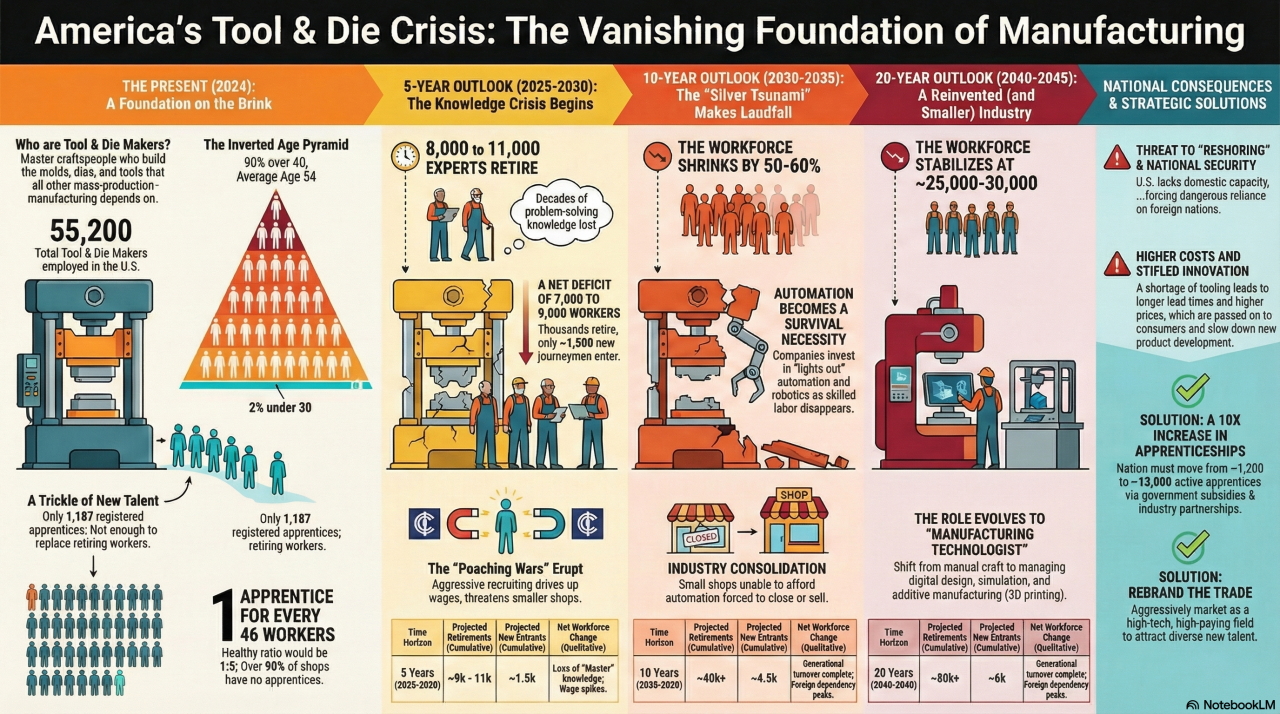 This graphic, from Scott Bedow, illustrates the demographic challenges that are leading to a nationwide decline in the tool and die industry.
One problem is the “Silver Tsunami,” a term used to describe the aging U.S. population – and specifically, the social and economic changes brought on by the baby boomer generation reaching retirement age en masse.
According to Bedow, the tool and die industry is particularly vulnerable to this shift, with 90% of its 55,000-person workforce older than 40 as of 2024, and with only about 1,200 registered apprentices in the pipeline to replace them. By 2030, Bedow estimates “that nearly 20% of the most experienced master toolmakers will retire, taking decades of ‘tribal knowledge’ with them that hasn't been digitized.”
“The cohort of workers that should be stepping into senior roles is nearly nonexistent, a historical fait accompli from the offshoring and educational shifts of the 1990s and 2000s,” Bedow writes.
“Our high schools and our counselors haven't been promoting skilled trades for a long time,” Hoffmann concurred. “They've been promoting college, and the idea that ‘you're not going to be successful if you don't go to college.’ The truth is that, if you join a company like ArtiFlex today as a 17- or 18-year-old, you're going to get an associate's degree paid for by the company, you'll have no debt, you'll be in an apprentice program almost immediately, with a rapidly rising paycheck, and by the time you're in your early 20s, you can probably afford to buy your own home, debt-free.”
The China factor
The exodus of young people from tool and die and other skilled trades created an opening in the market for other players to gain a foothold. Enter China, a country Hoffmann says “did not exist” on the tool and die landscape until about 30 years ago.
“In the ‘90s or early 2000s, what happened is the Chinese had a vision for building up an automotive industry that could not only compete with the likes of ours, but also Germany’s, Europe’s, you name it,” Hoffmann said. “They wanted to build a dominant industry, and the way to manufacture cars is to understand how the tools get made to make the parts. So, they had to start by building up a tooling industry, and the way to do that and to learn is to start doing business with North America.”
Early on, hefty government subsidies and cheap labor allowed China to gain a competitive edge in the global manufacturing market – even though Hoffmann says product quality often left something to be desired.
“In 2007 and 2008, when we did our first outsourced projects to China and Korea, the quality was suspect,” Hoffmann noted. “You really, really had to monitor closely all aspects of what they were doing, and they had very limited knowledge on the engineering of the tools.”
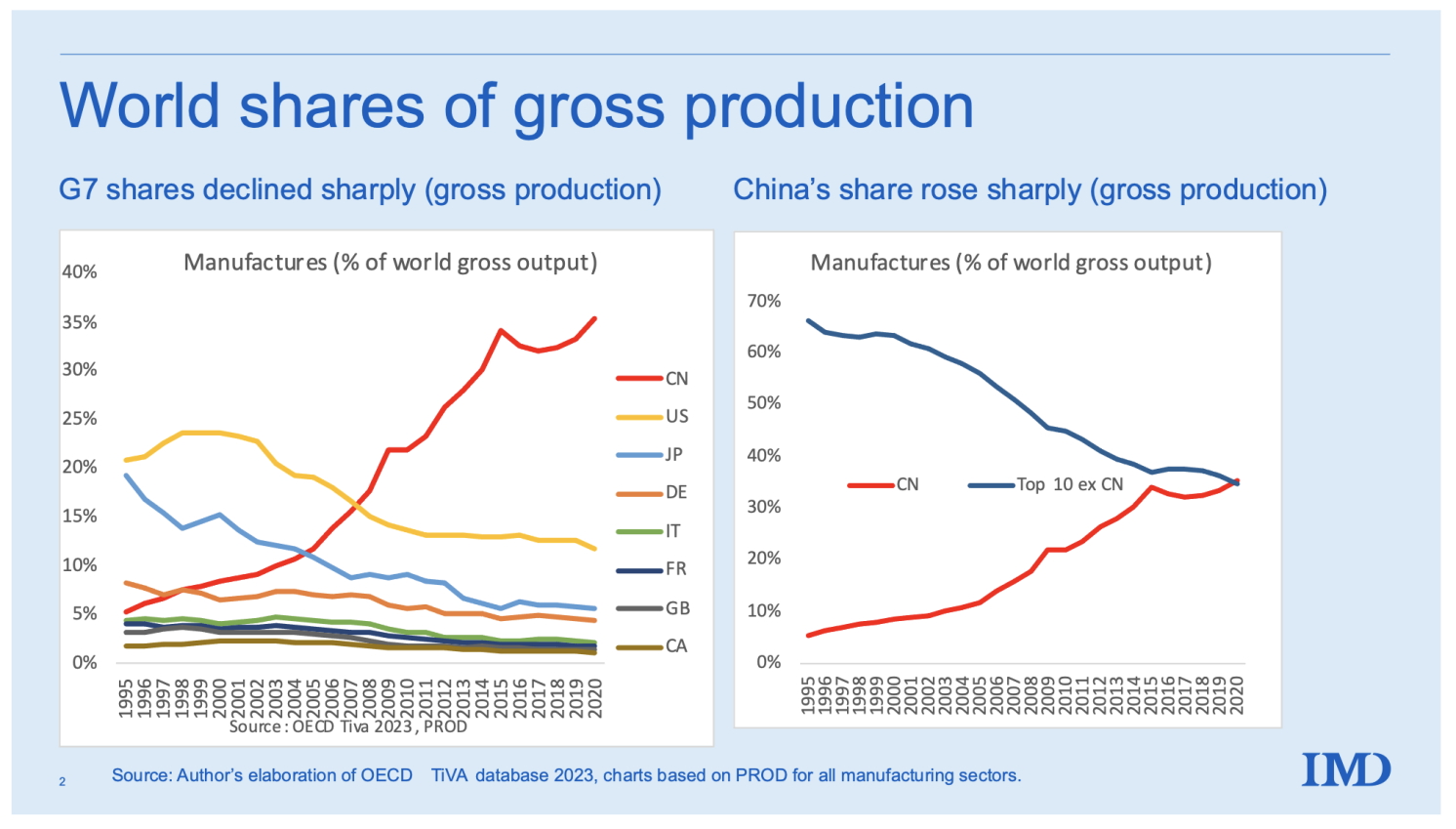 European think tank VoxEU used this graphic to illustrate the shifting powers of global manufacturing, and China's increasingly dominant position.
Fast-forward a quarter-century, and things have changed. China’s investment in manufacturing – not just on the subsidy side, but also in the form of aggressive R&D and strategic acquisitions of companies in other countries to build institutional knowledge – has made the nation a force to be reckoned with. In 2024, European think tank VoxEU dubbed China “the world’s sole manufacturing superpower,” noting that it now accounts for 35% of global output – “more than the nine next largest manufacturers combined.”
U.S. primacy on the manufacturing stage, meanwhile, has dipped from nearly a quarter of the world’s production at the turn of the century to 12% today. And the problem, Hoffmann says, is that China is no longer winning solely on price.
“Today, if you went over there, you could probably stop at 10 different places, and they would all be considered some of the best in the world,” he said.
Consequences, consequences
Bedow warns that America’s slide into manufacturing irrelevance will only accelerate if the country can’t reverse its tool and die problem.
“You cannot have ‘Made in America’ without the jigs, fixtures, dies and molds that make mass production possible,” he wrote. “If we lose the tooling base, we lose our (manufacturing) independence.”
Losing that independence, Hoffmann insists, is nothing short of a national security risk.
“All those new products that protect us and defend us? There has to be a manufacturing process to make those, and more often than not, there is some tooling applied,” Hoffmann explained. “The tool and die industry being unhealthy means it's very hard for us to tool up for the next major intervention. In World War II, we won by outproducing everyone else. We won by being able to increase production, and by using our automotive industry as the powerhouse and shifting its productive capacity into tanks and planes and submarines and ships. If we were to try to do that today, we’d need to build new tooling rapidly, and we're nowhere near what China's capability is to do that.”
 Hoffmann
Even beyond a hypothetical defense situation, Hoffmann says a healthy tool and die industry would do wonders to reshore more manufacturing to the United States, and to bring a spirit of innovation back to American industry.
As an example, he points to Tesla and its game-changing electric vehicles. There is innovation in the manufacturing of those vehicles, he says. But even though Tesla is an American company, much of that innovation is dependent on foreign companies.
“You can read about Tesla making giga presses and giga dies to make the casting of the car,” Hoffmann said. “They cast in one casting, and in doing so, they eliminate about 70 to 80 stampings. So, it's a very large, complex tool, and those tools are not built in the U.S. No shop in the U.S. has the capacity or the capability to build a giga die. You can’t even find one here, except for in Tesla’s facilities. Who’s making the machine? Well, the machine technology was originally developed by an Italian company, some German companies, and what was formerly an American company. But all that technology has been transferred to China, as they bought those companies. All those large machines are being made by Chinese companies. So, we're losing the race to innovate in process and development and design, because we don't make our own machines here.”
Bedow sees this “permanent loss of sovereign capability” as a harbinger of other problems, too: production bottlenecks, longer lead times, slower time-to-market rates, higher production costs “for all industries,” and end-consumer price hikes. He goes so far as to call the decline of American tool and die work as an “engine for inflation.”
Avoiding catastrophe
Avoiding that future, Bedow says, calls for “a national response,” including federal and state subsidies to offset the cost of training new tool and die apprentices; funding for “knowledge management systems” that could preserve the institutional knowledge of aging and retiring tool and die workers’ and rebranding and “aggressively marketing” the tool and die trade to young people – “not as a ‘dirty job’ but as a high-tech career in ‘industrial engineering and applied metallurgy.’”
Hoffmann, meanwhile, is calling for “minimum spending requirements” in the United States, to reshore a certain percentage of tool and die work and keep it domestic for good.
“We need to spend one-third of our dollars locally,” he said. “Require that for any program that's going to require new tooling that's going to run in this country. That would have a dramatic positive impact day one on the ability to invest in world-class tooling and equipment to build more productive die shops and mold shops, and to train the next generation.”
At the state level, Hoffmann says Michigan legislators could start advocating for a tax credit “for any investment made in new tooling build in Michigan.” That kind of change, he thinks, might be the easiest sell of all.
“If the tooling is being built here, it creates jobs, and those jobs that it creates have a ripple effect throughout the economy,” Hoffmann said. “For every dollar of revenue in tool and die, it creates about seven times that in the economy, which is a huge multiplier effect – much higher than you would get in any other market.”