'A Really Fun Run': Inside the explosive growth of Highstreet Insurance Partners
February 2026
Nine years ago, Highstreet Insurance partners didn’t exist.
Now, the company has more than 3,000 employees across 350 offices in 36 states, and $1 billion in revenue is a realistic goal (it hit more than $700 million in 2025). All told, it’s one of the top 25 insurance brokers in the country.
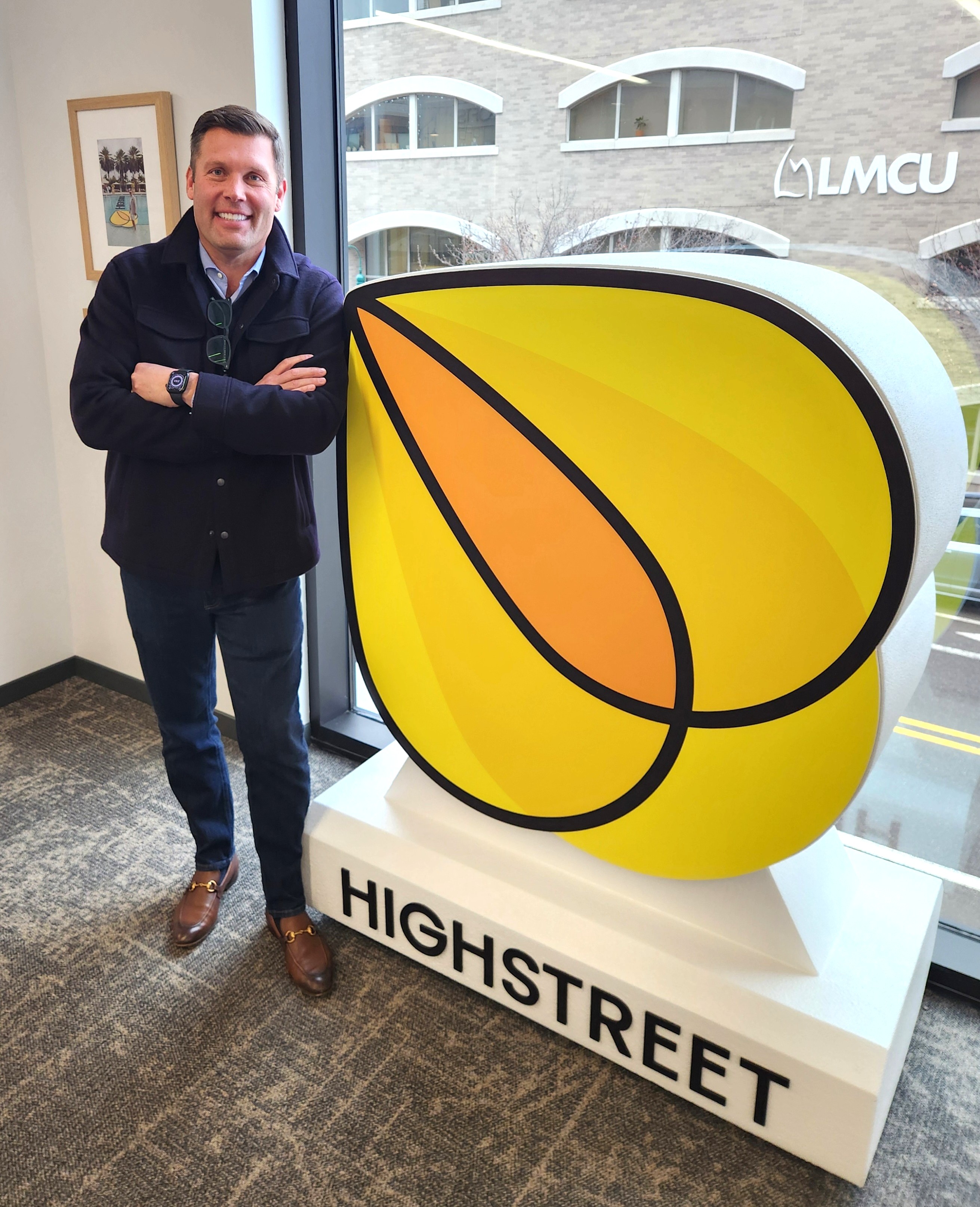
This entire operation is run from nationwide headquarters right here in Traverse City, where founder and CEO Scott Wick acquired the former Peterson McGregor & Associates as the very first in a massive (and growing) network of formerly independent agencies across the nation.
“It’s been a really fun run,” Wick said.
The TCBN sat down with Wick to learn more about Highstreet’s origins, growth and challenges.
The Mike O’Connor mindset
Wick grew up in small-town Wisconsin with schoolteacher parents. He ended up chasing glory and riches in Chicago, as many in financial fields often do.
“I was a salesperson who was only interested in writing the large, sexy accounts. The bigger the accounts, the better. The bigger the brands, the better,” he said. “The goal was to always move up the chain, make as much money as you possibly can, write the big accounts, see your name in lights.”
But Wick stumbled. Poor relationship management led to the loss of a few huge accounts and the need for a new path, personally and professionally.
“I needed to really think about the type of person that I wanted to be,” he said. “I probably wasn't doing a great job with my customers. I probably wasn't doing a great job with my friends. I probably wasn't doing a great job with my family. I probably wasn't doing a great job with my wife. The list goes on.”
It was around this time that he got to thinking a lot about the go-to insurance agent in his hometown of Belleville, Wisc.
“Ultimately what it came down to is I really started to reflect back on growing up in small-town Wisconsin, and [in my town], when you had an insurance-related question, you called Mike O’Connor,” he said. “He was the guy. Everybody would start with that phone call to Mike O’Connor.”
Wick wondered what would happen if you paired the impeccable customer service and familiarity of a Mike O’Connor with a deep bench of resources normally available only to large companies – essentially the best of both worlds.
“My thought process was, ‘Man, it would be really cool if Mike O'Connor was in a place where he could actually have the chassis, the solution bench, to take care of the customer in a really thoughtful [and complete] way,'" he said.
The business plan became simply that: Take agents and agencies in smaller and middle markets and arm them with much more tools, expertise and resources than they’ve ever had before. With that, tap into a “very sticky” base of customers who are already loyal to that agency and serve them even better.
Wick’s wife Megan is from Traverse City, and they moved the family here to start the Highstreet experiment in 2018. After acquiring Peterson McGregor, the company went on to add several more in Michigan and elsewhere, with 24 agencies acquired in the first two years.
Up, up and away
Considerable investment activity has allowed the company to scale rapidly, funding scores of acquisitions across the country. Boston-based private equity firm Abry Partners is invested to the tune of about 22%, Wick says, and just last August, Highstreet announced a round of $550 million in capital in the form of a delayed draw term loan from a group led by Ares Capital.
But Highstreet isn’t out to gobble up all the agencies it can. Several years in and with hundreds of acquisitions under its belt, the company is now being strategic and selective with the agencies it brings on.
“We actually look at every county in the United States and give it a score. We take a lot of different factors into place. Then we try to be very strategic and very specific about the type of acquisition or the type of partner we're looking for,” Wick said. “We defined the box early on. This is the type of agency we're looking for. This is the type of community we're looking for. This is the type of target customer we're looking for.”
A key part of the company’s success is acquiring agencies still on the rise, Wick says, with strong organic growth and management that’s still hungry.
“This isn't a retirement strategy. This isn’t, ‘Hey, I've built this really nice business over a lifetime, now how am I going to monetize it?'” Wick said. “[You look for agencies that are saying,] ‘Hey, listen, we truly are in a spot where we can double down on what we're already doing.’”
While “the proof is in the pudding” now regarding Highstreet, agencies who value their customers still sometimes need to be sold on being acquired by the company, Wick says.
“All of these insurance agencies have been called on by some potential buyer. We’ve seen so much consolidation in our space,” he said. “I think one thing I’ve found myself being able to say to them is, 'I respect and understand who your target customer is.’”
They’re also greatly wooed by Wick’s initial concept: What if you had more tools at your disposal?
“They might be sitting there saying ‘I'm a heavy personal line of insurance agency. Maybe don't have the commercial lines expertise. I don't have the employee benefits expertise. I don't have the wealth expertise. I don't have the cyber liability expertise,'” Wick said. “Now they have the ability to bring those resources to bear and take care of their customers the best way they can.”
Wick is also able to sell them on joining something bigger.
“You're sitting in your agency in whatever small town, you're a single owner or maybe you have one partner and you're like, ‘I want to do more. How am I going to do more? What am I going to do?'" Wick said. “The fact that you can sit around the table with more partners, with more people that encourage you to grow or take chances, do those types of things, that's a fun spot to be in.”
And make no mistake: Just because these are mostly small agencies doesn’t mean they only want small customers. Joining up with Highstreet has given them the swagger and tools to pursue much bigger fish.
“You have to do transactional personal lines really well. The one home, the two cars,” Wick said. "But you also have to have a chassis that can support the high-net-worth strategy as well. What are you doing for the folks that live on the peninsula? What are you doing for the folks that have one, two, three, four homes? What about [the major employers?]”
Highstreet’s book of business is about 35% personal insurance, 40% business/commercial insurance, 20% employee benefits and 5% other, Wick says. While the company may test certain “adjacencies” like tax advice, there’s still plenty of growth opportunities in their current market.
“I think there's an awful lot of meat on the bone to keep doing what we're doing right now,” Wick said.
Traverse City … for now
By and large, Wick is glad to be in Traverse City. He and many of his employees (almost 90 here, between Highstreet corporate and local rank and file) enjoy the region’s natural beauty and outdoor culture, among other attractions.
He also loves working with the area’s talented local vendors. Ask him about Bonnie Alfonso at Alfie sourcing his team’s custom Air Force Ones or Allison Beers at Events North handling his many nationwide events. Across the country, he says, Highstreet’s branches prioritize local business relationships by matter of principle.
“What we've tried to do is plug local companies in when we have the opportunity, even if we're paying more,” he said. “Because I think that if you're going to build resilient communities, you have to find ways to help others grow.”
But there are challenges here, Wick says, particularly in talent attraction. He also has a nationwide management team of more than 200 that he’d like to eventually consolidate into one place. While they’d like to do it here, Wick says they’re in the process of determining if that’s feasible.
“I think if we stay on the growth trajectory that we're on, does [Traverse City] have the infrastructure? Does it have the resources? Does it have the foundation to support as big of a move as we'd be making to bring all of these people here?” Wick said. “So that's something we're in the throes of right now. We're thinking really long and hard about if Traverse City can be a place that we think we can scale this business for the long term.”