Keeping Pace: NMC’s computer information tech program keeps up with latest in trends, cyber threats
January 2026
It was more than 25 years ago that Scott Goethals, now the program director of the computer information technology (CIT) program at Northwestern Michigan College (NMC), came aboard as part of the college’s early forays into computer education.
A quarter-century later, it would be difficult to think of another NMC program that has evolved more dramatically than CIT. Though a commonly used tool by the turn of the century, the internet wasn’t the all-encompassing driver of communication and commerce that it is today – to say nothing of the myriad new technologies and cybersecurity threats that have proliferated between 2000 and now.
All the change begs the question: How does the world of academia, so often grounded in the well-established facts that can be printed for evergreen posterity in a textbook, maintain a handle on an industry as ever-changing as computer science? We sat down with Goethals to find out.
According to Goethals, NMC’s CIT program was still in relatively rudimentary form even at the end of the 2000s. Most of the evolution, in other words, has happened in the last 15 years.
“At one point in time, we had a single program, and it was a general degree that was designed to prepare students for careers in information technology [IT],” Goethals explained. “That program included a little bit of everything. It centered around folks getting skills not only in the networking infrastructure side, which is what we typically think of networking, but also on the software development side, where people would learn how to develop software and write applications and things of that nature. It was what I would call a balanced, generic degree.”
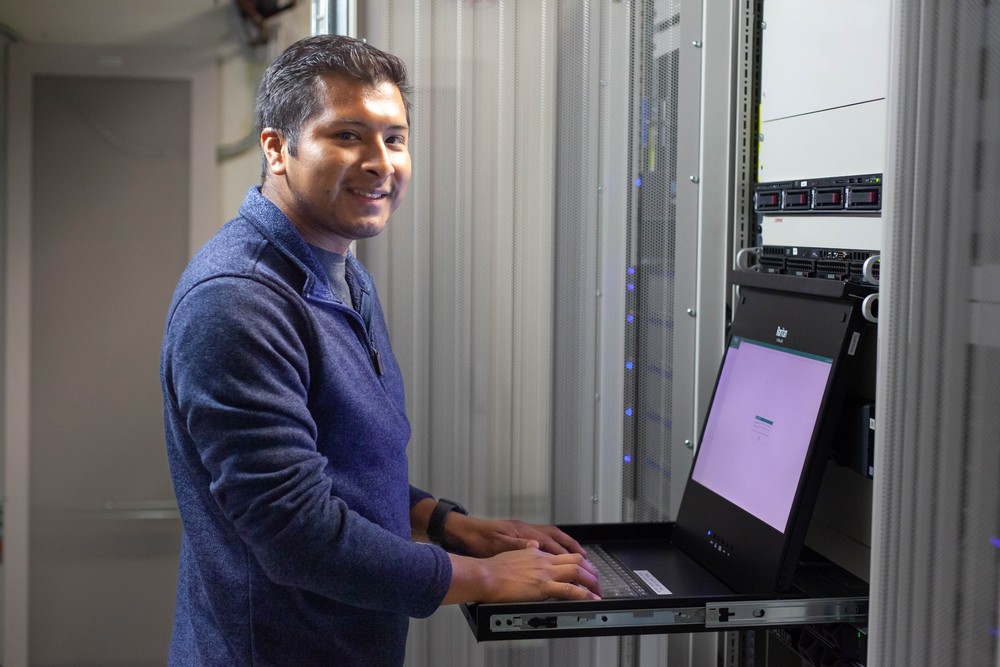 NMC student David Hipolito
Around 2008 or 2009, Goethals says the program was encouraged by its advisory board to split those two pathways into separate associate’s degree programs.
“We had students that would say, ‘I'm not going to be a developer. Why are you making me take these development classes? I just want to focus on the infrastructure, the networking, the systems,'" he said. "And then we had other students that said, ‘I just want to do programming. I'm not going to do that other stuff.’”
That expansion, from a one-size-fits-all model to a two-pronged approach, marked the biggest juncture yet for the program, and helped establish it as a modular educational path that could adapt to the latest trends.
More evolutions were to come. Toward the end of the 2010s, for instance, the college tweaked its computer infrastructure program, characterizing it as an associate’s degree in applied science and CIT infrastructure to include more of a cybersecurity focus. The program gained three security-focused courses and was rebranded as an associate’s in CIT infrastructure and security.
“The reason for that is, for years, people thought of cybersecurity as an IT issue,” Goethals explained. “When professionals talked about cybersecurity, they’d talk about it in the context of protecting the systems, protecting the network. Now, cybersecurity isn’t just viewed as an IT issue; it’s viewed as a business issue. If you think about it today, most organizations require their employees to go through at least yearly cybersecurity training, centered around phishing, business email compromise, scams, privacy, all of those things. Everybody in an organization has to be diligent about where the threats are, and that’s changed the job of the cybersecurity specialist.”
Keeping an eye on those changing trends – and adapting programs to align with the latest industry certifications – has allowed Goethals and his team to keep NMC’s CIT programs in a position where they can be useful to students and employers alike. Beyond the two associate’s degree pathways, the college also now offers multiple standalone or stackable certificates, including shorter-form programs in cybersecurity, infrastructure, web development, computer support and even Microsoft Office applications.
Partnerships are a key component of keeping NMC’s program on the cutting edge, as well. As is the case with many other NMC departments, the CIT program has longstanding connections with local industry, organizing regular “CIT Industry Night Out” events where technology leaders at local businesses host student information sessions.
“We try to do one of those every month or so,” Goethals said of the Industry Night Out sessions. “The host business will invite our students in, provide some food and drink – usually just pizza and soda – and then our students get a chance to hear from the organization’s IT leaders, cybersecurity people and programmers. In the past 10 years, I think we’ve done 44 of those events, and the community connections have absolutely led to internships and job opportunities for our students.”
Goethals is proud of that employability factor with his students, many of whom start working for local businesses while they are still working on their degrees. Current students John Brumbaugh and Zac Crowell, for instance, are both working at Munson – Brumbaugh on the help desk, Crowell as part of the network engineering team.
Also at Munson is Stephanie Cardwell, a 2014 graduate of NMC’s CIT program who now serves as senior network engineer and team lead for the healthcare system. Cardwell has paid her success forward by by conducting occasional “cybersecurity tabletop exercises” with NMC, which Goethals says are extremely valuable for giving students a sense of what life can look like on the job.
“A tabletop exercise is where Stephanie comes in and she has a scenario in mind,” Goethals said. “It could be something like, ‘OK, we just had a ransomware breach, and the person who heads up the cyber side of the organization is on vacation. What do we do?’ And then you work through the scenario with regards to how it impacts your organization.”
Also in NMC’s program are local employers like Thrive (formerly Safety Net), Skilled Manufacturing and Frontier Computer, all of which Goethals says have hired numerous CIT program graduates over the years. Frontier Computer hosted the first-ever CIT Industry Night Out event a decade ago, and all three organizations have team members who serve on the CIT program advisory board.
The partnerships reach outside of the immediate local area, too. Per Goethals, many of the CIT program’s graduates will matriculate to four-year institutions for further study. NMC has an articulation agreement with Ferris State University specifically built to streamline that pathway.
“They have a bachelor's and a master's degree in information security and intelligence, or ISI,” Goethals said of Ferris. “So, a lot of our students will go that route.”
If there’s an elephant in the room for Goethals and his students these days, it is artificial intelligence. Unlike the many industries and employers having debates about whether to embrace AI, though, Goethals says cybersecurity professionals are unique in that they really don’t have a choice in the matter.
“You can be certain that the threat actors out there are finding ways of using AI to become more sophisticated with their attacks, to automate methods of trying to breach into a network or into an organization,” Goethals explained. “And at the same time, the software companies and the technology companies that develop products are also implementing AI as a way to reveal these types of breaches and attack methods. So, both the red team and the blue team are using AI.”
Regarding fears that AI is erasing jobs in the CIT industry, Goethals lands somewhere in the middle.
“There have certainly been a number of large organizations – Microsoft and others – that have laid off people, but I'm not completely in belief that it's all AI driven. I think the economy and other things are a big factor in that, too,” Goethals said. “Ultimately, my view is that AI is a tool, and should be used to help us do things more effectively and more efficiently. Right now, we’re finding ways to implement AI in our classes, which I'm looking forward to. Just recently, I had approval of a new course go through our curriculum committee that we're going to be offering next fall on generative AI.”