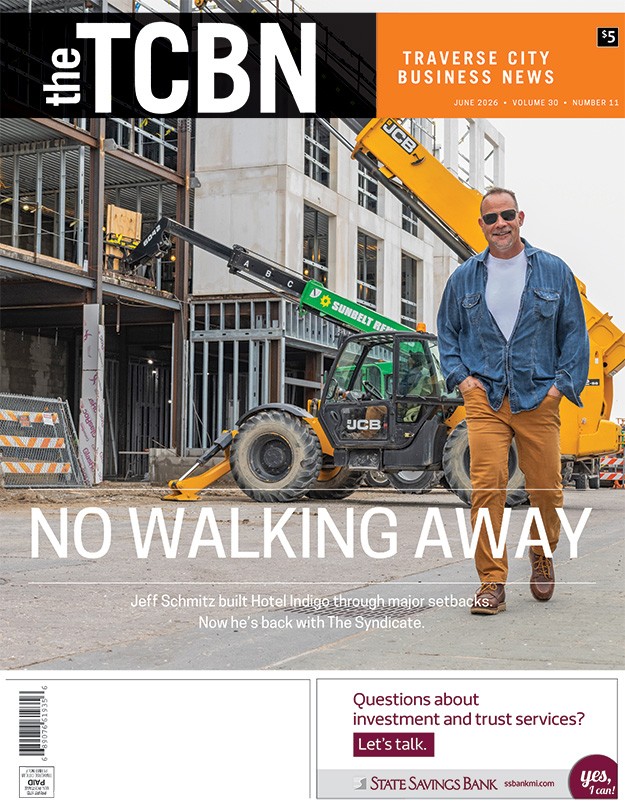
'You've Just Got to Keep Rolling': Inside the mind of Jeff Schmitz, Traverse City's most unflinching developer
June 2026
Jeff Schmitz isn’t going to rest on his laurels.
There's a better chance he burns the laurels and scatters the ashes into the wind, maybe at the Arctic Circle (more on that later).
Even if a development project is a hit by all accounts – even if it looks good, turns a profit and earns rave reviews – he’s more interested in what went wrong than what went right.
Schmitz has been watching as his latest local hotel project, the ambitious Syndicate, rises along Grandview Parkway across from the Open Space and next to Hotel Indigo (his first Traverse City project). When it’s completed sometime in 2027, he’ll be there taking notes.
“We’re going to build this hotel, and the day it opens, I’m going to criticize every single part of that asset … I’ll be bitching about everything,” he said. “I’m going to say, ‘Well, I can do it better next time.’ All you think about is, how do we get better tomorrow?”
This mindset has been key as Schmitz and his Rochester-based J.S. Capitol group have developed more than four million square feet across more than 100 projects around the country over the past 20 years.
The TCBN connected with Schmitz to learn more about what makes him tick – and what he thinks of the northern Michigan market.
Getting started
Schmitz grew up in the Detroit area and “barely graduated” from Rochester Adams High School before attending and playing college football at Ferris State University, where he remains a major donor.
“I started off in construction management, but I realized that it wasn't the path because construction management courses and football practice didn’t align,” he said. “So I switched my major to small business administration and graduated.”
He spent some time in construction before quickly opening up his own company, working basic builds as a general contractor. Hard work led to connections, and connections allowed for growth. He landed a big job remodeling the Pontiac Silverdome, and at only 25 landed his first contract to build a hotel – this one a Holiday Inn Express in Canton.
“When they interviewed me for the job, I told them I was 32,” he recalled, laughing.
After the 2008 economic downturn, he made use of millions of dollars of so-called GO Zone bonds (Gulf Opportunity bonds; tax-exempt federal bonds authorized by Congress to rebuild after Hurricane Katrina) for a variety of projects in Mississippi and Alabama.
It was through these projects that he ended up owning his first hotel (he built a hotel for a person who couldn’t pay him, so he took it over). This was the start of his transition from contracting to development and ownership.
“My vision was to eliminate working for anyone ever again other than myself … so I started developing my own assets in Mississippi and then in Dallas,” he said. “I figured f--- it, if these other guys can do it, I can do it just as good or better, and if you own a hotel or another asset, you’re making money while you’re sleeping.”
He found that developing got his juices flowing. It still does – big-time.
“Being a real estate developer is one of the few things you can do where you can wake up in the middle of the night and have this idea of something, go look for a piece of dirt and then create something out of your mind,” he said. “You employ a bunch of people, and then when it's done, you can touch it, feel it. And it's a tangible thing, right? You take your own vision and then actually dial in and get it done. It’s really a fantastic thing.”
He now has about 600 people working in developments he built and still owns, ranging from a network of daycare centers (Premier Academy) and car washes to cannabis facilities, restaurants, apartments, hotels and senior living facilities.
“We’re in a lot of different spaces right now,” he said. "(And) I challenge my asset managers and my president: What are we doing to be better than we were last year, not from purely an economic standpoint? How are we managing our people and our processes better than we did last year? We have to keep pushing.”
Schmitz learned that he deeply enjoys owning and running operations after he’s built them, even though it means he’s on the hook for their financial performance.
“A lot of developers … put it all together and turn it over. They deal with the architects, the engineers, they hand it all over and get paid a fee. That’s just not very exciting for me. It’s nothing tangible. I’m just working for a paycheck at that point,” he said. “But when you own them, you do take on all of the risk.”
He doesn’t own and operate everything he builds forever, though, and he figures he’s sold about half of his properties over the years.
“I'm not a fan of selling assets, but in the real estate world, you can either raise cash, bring in a whole bunch of partners in certain different developments, or you can get liquid and sell a few assets,” he said. “Everything is for sale, so don’t fall in love with that asset.”
One of those sales was the Hotel Indigo, which he built for around $17 million and sold it less than three years later for about $26 million.
“At the time, (I'm told) it was the highest price per-key sale (in Michigan history),” Schmitz said. “And we netted a little over $2 million a year for the two-and-a-half years we owned it.”
Perseverance and smart people
About Hotel Indigo: That project leveraged another key to Schmitz’ success – one of the biggest, he figures.
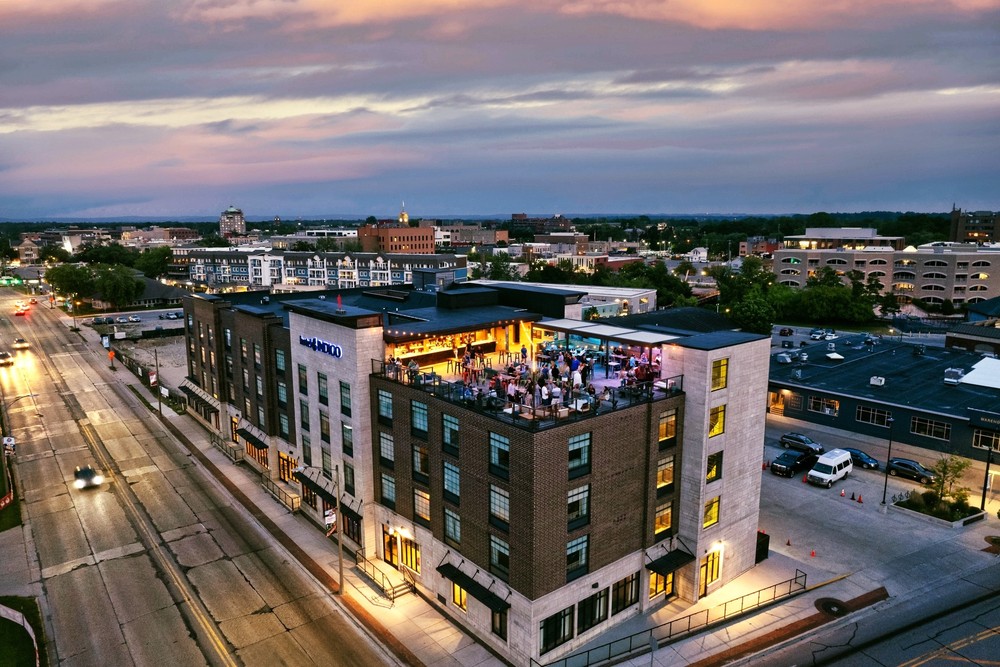 Hotel Indigo
“It is 100% without a doubt all about perseverance,” he said. “You’re going to get the f--- knocked out of you so many times if you’re an entrepreneur, but you’ve just got to keep rolling, man. You’ve got to push through.”
Indigo was an absolute slog for a variety of reasons, ranging from unexpectedly high groundwater contamination to water table issues, financing troubles, very rough weather and more.
“You just look at all of the disasters I dealt with at Indigo, and I can’t tell you how many developers came up to me and said ‘I can’t believe you didn’t walk away from that deal,’” he said. “Again, it’s 100% about perseverance in anything you do.”
A few years ago, he decided he wanted a dose of physical and mental perseverance, so he spent six and a half weeks in a tent in Grise Fiord, Nunavut – one of the northernmost settlements in the world.
“I lost 40 pounds. You're so f------ cold every day that your body's just burning calories. The warmest it ever got was minus 45. (But) you have to push yourself as a human being to be comfortable being uncomfortable.”
It just made him miss work more, he says.
"The thing that I think I learned the most is I couldn’t wait to get back to the f------ grind,” he said. “My kids thought – everybody thought – that after I came back I was going to retire. But it was totally the opposite. It made me want to go, go, go.”
Schmitz is detail-oriented, particularly when it comes to the look and feel of his projects. It’s the little things, he says, that can elevate a property.
“I get involved in every stitch, in every detail,” he said. “There's not a pen that goes in those rooms that I don't approve.”
But this doesn’t mean he micromanages. In many facets of his operations he knows when to step aside and delegate to people who are more capable than him. This is a trait that can be fleeting in leadership and one he believes has played a massive role in his fortunes over the years.
“A key to my success has always been that I hire people who are way smarter than me. And that’s 100% real,” he said. “My stepfather …was a nice guy, brilliant guy. Chief operating officer for Caterpillar. One day he said to me, ‘Jeff, if I had my brains with your balls, I’d be a billionaire.’”
Schmitz has certainly grown wealthy in this business, but it’s not what drives him.
“The happiness comes from the journey,” he said. “It’s not about how much money you’ve made. Money is just a tool in my business. It’s just like if the carpenter forgets his hammer at home, he can’t go to work. If we don’t have any money, we can’t go to work.”
Traverse City market
Schmitz was initially attracted to the Traverse City market when the landowners of what is now Hotel Indigo grew frustrated by talks of a hotel on the site going nowhere. One of them contacted Schmitz, he says, because they heard he has a reputation for getting things done.
“And so I went up there. I loved the site, I loved the growth that was happening. And back then, they really didn’t have a marquee hotel property. (So) I said, ‘We got to do this deal,'" he said.
Now he’s working on the Syndicate, a four-story, 110-room hotel that will be a Marriott Bonvoy franchise. It will feature a ground floor restaurant, spa and fitness center,
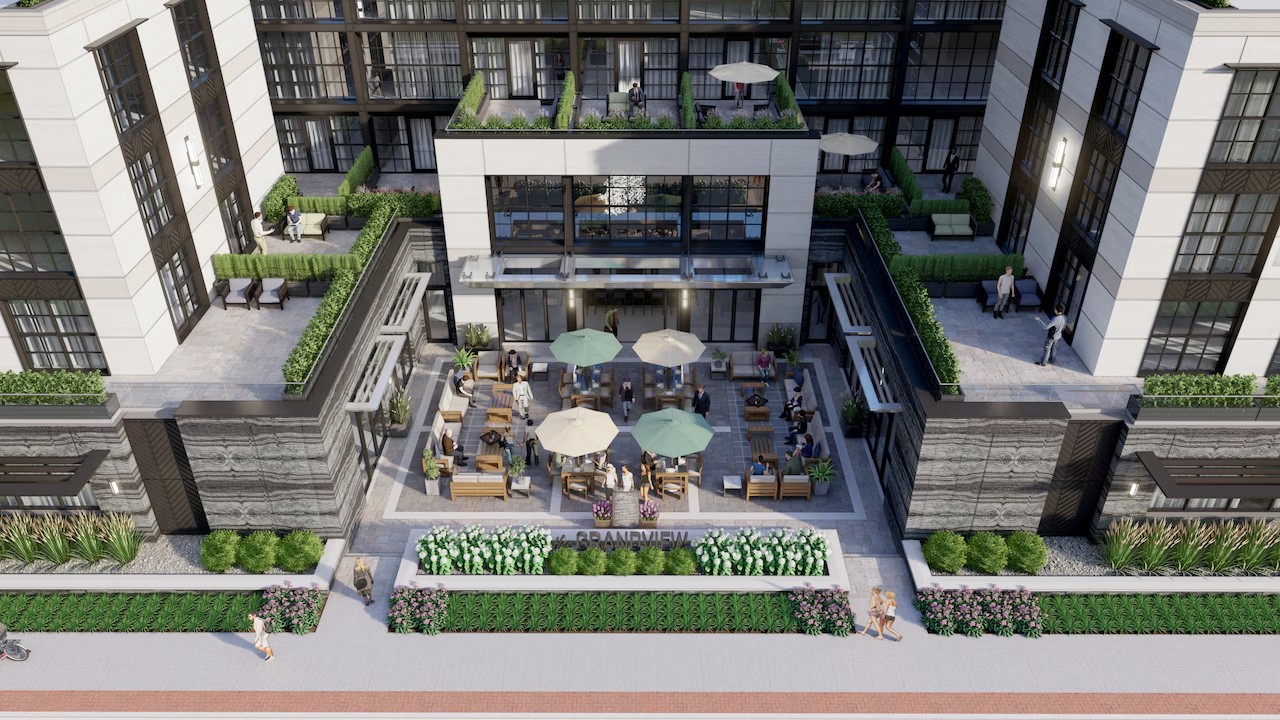 The Syndicate
 banquet room and three board rooms. Like the neighboring Indigo, it will have a rooftop bar space.
The project has been largely smooth sailing thus far, especially compared to the Indigo, though this past winter gave him serious flashbacks to the polar vortex winters of 2014-15 when the Indigo was getting started.
“Between December 10 and just a few weeks ago, we probably only got 40 working days on that project. And we tried everything. We tented that first floor to try and make something happen, but those winds were just howling and it was so cold,” he said. “I bet you I’ve spent over 100 grand just in propane (trying to heat the space)."
Traverse City has been a welcoming place to work, Schmitz says.
“The people in Traverse City have been extremely wonderful. The general population, the other business owners, I think they've been fantastic. You can't ask for better hospitality from a town like Traverse City anywhere in the country,” he said. “I’ve had a great relationship with the city. The planning commission has been wonderful, the DDA has been wonderful. It’s been a real treat to work with these people.”
That said, he’s still chapped about certain facets of the municipal experience.
“I’ve never seen property taxes in a city like that anywhere in the world,” he said. “I ended up with a million dollars in interim property taxes during construction (of Hotel Indigo).”
And there are, of course, other downsides to this market. For one, land costs and competition are higher than ever before.
“The cost of entry is just huge – it’s really hard to get a deal done without using private equity or credit up there,” he said. “And there’s a lot of private equity money. The big players are really entrenched in Traverse City. And I don’t play in that world. I don’t want to play in that world. But you’re seeing a ton of money being dumped into that town.”
It’s also hard to find reliable and reputable construction workers up here, he says, and he’s getting a bit tired of that northern Michigan markup.
“Cost of entry becomes your biggest problem, and your second biggest problem is … your labor market is just awful. And then there’s construction costs," he said. "For example, drywall is a dollar more per square foot up there than it is down here.”
Then, like everyone else, once Schmitz has built and is running a business, he can’t find employees. Housing is perhaps the biggest reason for that, so he’s taking matters into his own hands.
“We’re buying a couple of duplex homes up there, and we’re going to house our own people in the summer months,” he said.