Small but Mighty: Childcare 'microcenter' model might boost region
July 2026
Business leaders hope a childcare model piloted in Leelanau County could provide massive relief in the region’s ongoing childcare crisis.
In short, the childcare “microcenter” model allows the state regulations for home-based childcare operations to apply to operations based someplace outside of the home, like a room at a church or township hall.
If approved statewide, these could fill a substantial gap between home-based childcare and traditionally licensed, standalone daycare centers, which are considerably more difficult to open and operate from a regulatory and business standpoint.
Three of these operate in Leelanau County right now, but they are not (as of yet) legal anywhere else. Local business leaders are pushing legislation to make them legal statewide, with hopes that could happen as soon as next year.
“The team in Leelanau County has not just piloted this, but they have demonstrated that it’s successful,” Traverse Connect President and CEO Warren Call said. “This is not a concept – this is something that is working already.”
A growing crisis
Childcare availability and affordability have long been significant issues across the state. A recent Michigan State University study found a lack of access to childcare costs the state’s economy $2.9 billion in lost productivity as working parents struggle to find good care for their kids.
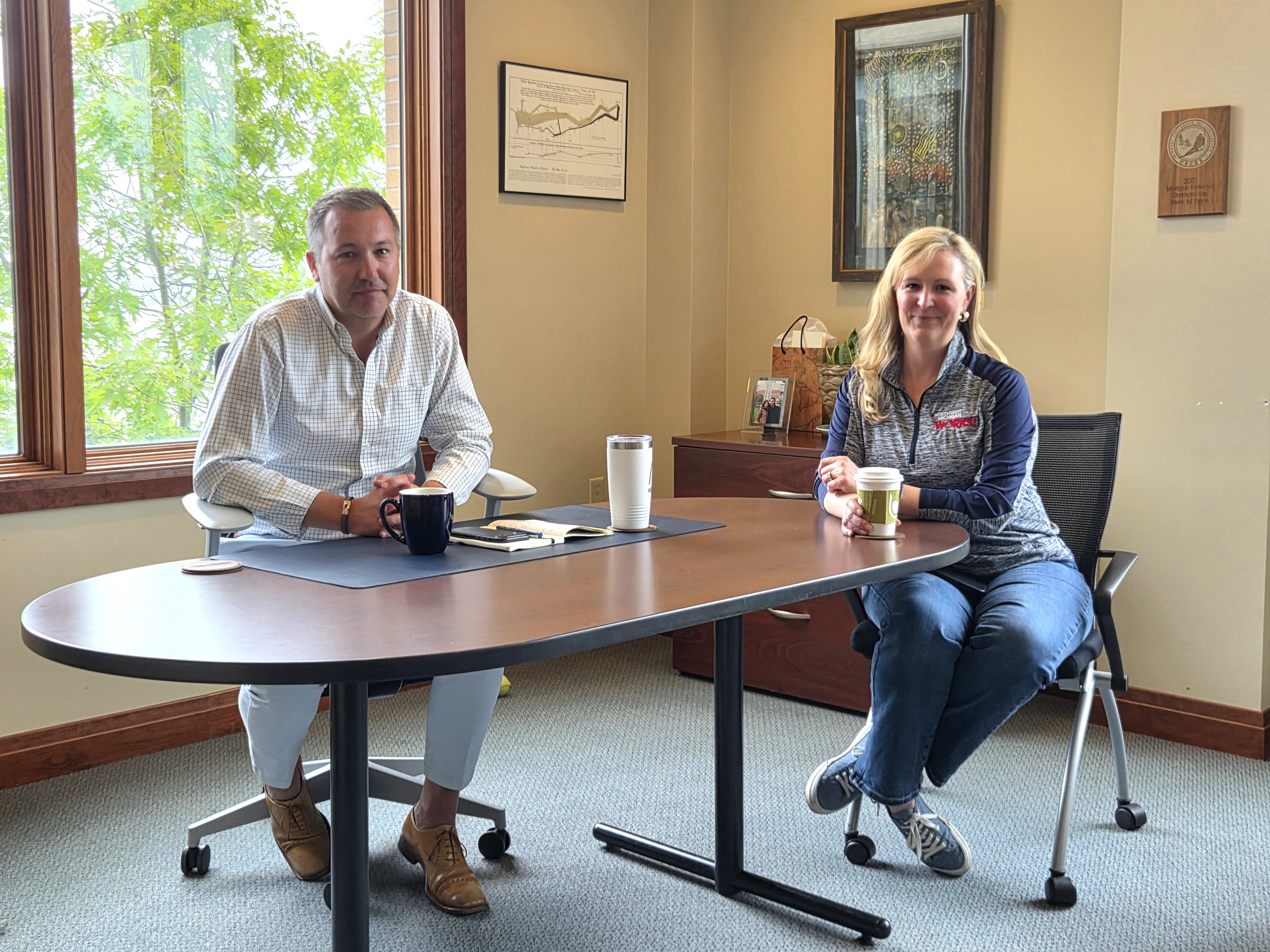 Call and McNabb
Perhaps no region faces more of a crisis than northwest Michigan, where business growth is increasingly hampered by a lack of childcare.
“This impacts workforce availability on a major scale. When there’s not affordable, accessible childcare, it’s hard to get to work … and you’re less likely to be able to recruit people into this region for work,” Call said. “This is a top three barrier to our economic goals and prosperity in this region.”
Networks Northwest, a 10-county public agency that focuses on workforce development, business support and regional planning, recently determined that there’s a need for full-time care for about 2,600 children up to age four, and that that need is largely going unmet, with surveys showing 70% of people in the region struggled to find childcare.
What’s more, this problem is climbing up the social ladder.
“It’s always been a problem for people on the lower end of the income spectrum, but it has now broadened in crisis proportions to way, way more income levels,” said Janie McNabb, CEO of Networks Northwest and Northwest Michigan Works!
Lack of good childcare, of course, has impacts far beyond those to businesses.
“When you don't have a licensed, quality place to put your child, you end up in desperate situations,” McNabb said. “We see it at Michigan Works where people are forced to leave their children with people they don't necessarily know and trust. And the safety factor there is at the very least questionable.”
A northern Michigan solution
In 2022, a group in Leelanau County came together to discuss improving and expanding childcare options there. Many home-based centers had closed and weren’t being replaced, and they decided to figure out why.
 Soutas-Little
After getting a grant to fund more in-home programs by covering startup costs, they discovered that a big hangup was that while people were willing to run daycare centers, many weren’t overly excited about doing it in their homes.
“We found two, but we couldn't get anyone else to step forward even though we were paying for the startup in total,” said Patricia Soutas-Little, chair of the Leelanau Early Childhood Development Commission. “People just didn't want to do it in their homes for a whole variety of good reasons.”
The problem is that the cost and regulatory barriers to open a traditional, outside-of-the-home daycare center are simply too high for the average person who’s looking to run a small, in-home operation.
So the Leelanau team pitched a happy medium to state regulators: Allow in-home regulations to be applied at off-site locations. This means more manageable staff-to-child ratios (1:6 instead of 1:3 for the youngest kids), but it also means far less regulations on facilities, equipment, training and more.
Under this “microcenter” model, at least one individual (microcenters allow up to 12 kids supervised by at least two people) strikes a partnership with someone who owns a space. They rent that space for a dollar and run a daycare there, with the landlord responsible for all building matters and the tenant left to handle all matters of the daycare business itself.
This was the only way around the obvious downsides of moving a program out of the home.
“When you take it out of a home, now you're looking at having to pay rent, having to pay money to plow your parking lot, pay your utilities, etc.,” Soutas-Little said. “So how can we get around that? Well, we created a situation where it's a partnership.”
State regulators approved this for Leelanau only, and in that county, three programs have been run for more than a year in a church in Glen Lake, a school in Suttons Bay and a village-owned facility in Northport. These communities have rallied around these centers, Soutas-Little says.
“Each of these communities feel that this microcenter is theirs and they are willing to donate their time and energy, and it's really been a beautiful thing to watch that materialize,” she said. “They’re invested in them.”
Soutas-Little says a recent parent and provider survey shows the model and the microcenters themselves have been “enormously successful.”
“We were blown away by the results. The families love these programs, they love the providers,” she said. “Many of them have been able to go back to work where they weren't able to before because they have the care, this kind of thing.”
Legislative push
McNabb and Call testified before the state Senate earlier this year in an effort to support expanding microcenters outside of Leelanau County.
“Childcare microcenters offer a scalable, cost-effective solution to Michigan’s rural childcare crisis. These small, owner-operated facilities blend the intimacy of home-based care with the structure of licensed centers,” Call said to the Senate. “They promote community partnerships, reduce staffing burdens and expand access where traditional models fall short.”
McNabb says the cost and regulatory savings presented by microcenters are likely to encourage far more people to wade into the childcare game (especially those who were already inclined, but not excited about offering up their own homes). This would not only help alleviate the childcare crisis, but also provide more high-quality, highly valued jobs.
“Even if it's a one-person provider, they are a small business. They are paying their taxes and abiding by regulations,” she said. “What a great chance to open up this business opportunity to more people.”
They also expect the microcenter model to spread out the physical locations of childcare, something that will be greatly beneficial in rural areas like most of northern Michigan.
"Right now we have people driving extensive distances just because that's the only place they can find care,” McNabb said. “So this is going to make it possible to spread out where those centers are located.”
So, what are the next steps in getting this legalized across the state? The proposed Michigan State Senate Bill 733 would allow for it. But as of right now, it doesn’t appear to be going anywhere fast.
“As with so many things in Lansing, it's an imminently logical and practical idea, and partly for that reason, it hasn't moved as fast as we would have hoped,” Call joked.
Call says the current political environment is simply not favorable for expedient approval. The state house and senate are not moving each other’s bills, and there are more pressing issues to tend to.
“Ideally, because this is something that's pretty practical, it could go through both chambers and get the governor's signature. That's what we're hoping for. But it may take a little bit of time,” he said. “The state budget is the big thing right now, and then as soon as that’s over, the focus is going to go toward the election. So we may have to wait until after the election to see movement on some of these things, this bill and many others.”
Still, he hopes for approval within the next year.
Munson To Expand Childcare Program
Munson Healthcare broke ground on a $1.5 million expansion for its in-house childcare program.
The expansion, located at the Foster Family Community Health Center in East Bay Township, will create space for 137 additional children and is expected to be open by the end of 2026.
Munson already provides care for 500 employee children across three locations in the Traverse City area. Megan Brown, Munson’s chief marketing and communications officer, said the wait list for the program has hovered around 100 children for several years, though it has risen as high as 200.
“Currently our wait list is at just over 100 children, and our goal with this expansion is to eliminate that wait list,” she said.
Munson employs almost 70 people for childcare and has been providing it since 1991. Brown says Munson is glad to further expand the program, which operates at a loss for the system but provides a vital and necessary service.
“This expansion really does embody our commitment to care for the people that care for our patients every day,” she said. “This is about building a strong culture…and ensuring peace of mind for Munson employees.”
But there are also very strong business reasons to continually invest in childcare. Offering childcare is “critical” for employee recruitment and retention, Brown said.
Pictured top: Rooted Daycare in Glen Arbor