Potato Power: Massive regional production often flies under the radar
April 2026
Seventy-two million pounds of fresh potatoes. More than 3,500 tons.
No, that’s not the state’s annual production, or even the region’s. That’s just one outfit (Kitchen Farms) along U.S. 31 just north of Alba. Slide south near Kalkaska to find Jenkins Potato Farm, which cranks out another 25 million pounds each year. And in northern Michigan, the list goes on.
Between Kalkaska and Antrim counties alone, more than 8,000 acres are used to grow millions and millions of pounds of potatoes. That’s a healthy chunk of the roughly 50,000 acres dedicated to this versatile crop throughout the state.
All of this is largely under the radar for the average regional resident, especially compared to higher profile crops like cherries and apples.
“The potato industry in Michigan is extremely impressive … and in northwest Michigan, we have an incredible growing region," said Michigan Farm Bureau president Ben LaCross, himself a Leelanau county cherry grower. “It speaks to what a modern marvel agriculture really is. You could have such a massive economic driver and huge production in the region, and people in Traverse City don’t even know about it.”
While Michigan ranks first in the entire country in potato production for potato chips (industry advocates boast that one out of four bags of potato chips sold nationwide are made from Michigan potatoes) most farms in northwest Michigan grow potatoes for fresh consumption.
“The reason all of us [grow for the fresh market] in this area is because of the sandy soil,” said Bruce Cotton of Elmaple Farm near Kalkaska. “It’s better for disease, and versus heavy ground, it gives a much better lasting potato.”
The TCBN took a grand tour of regional potato farms to learn more about this important industry.
The spud scene
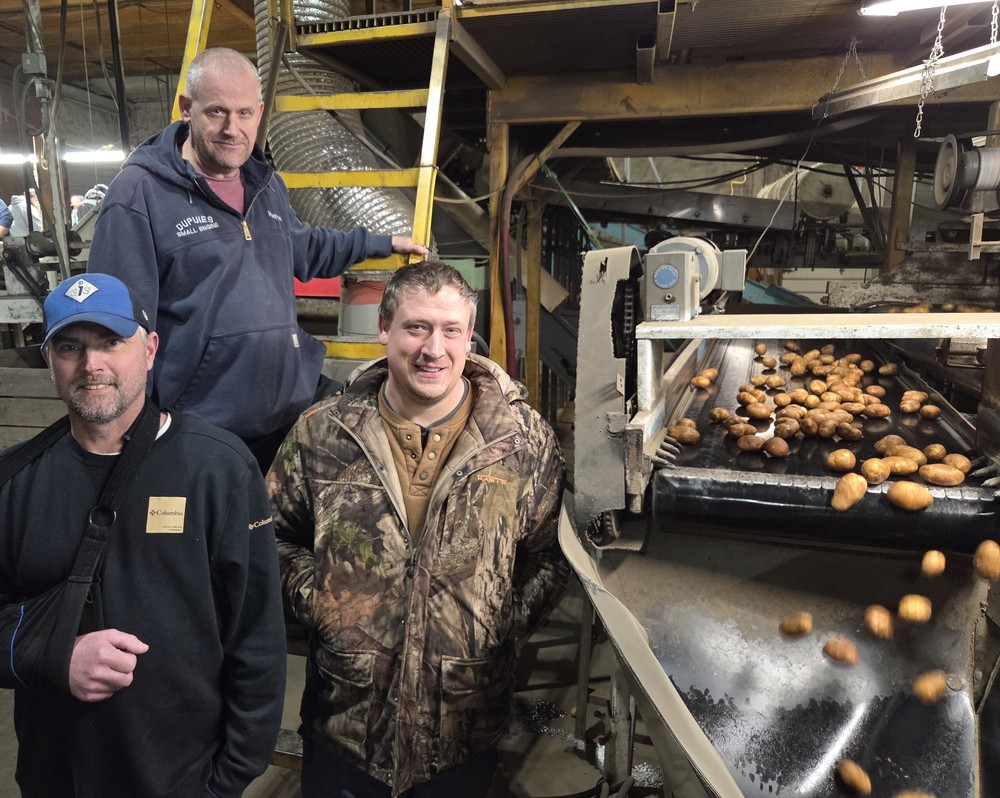 Troy Jenkins, Ryan Arsnoe, Nick Arsnoe of Jenkins Potato Farm.
The potato is grown as an annual crop, generally planted in May and harvested over a few weeks in September with massive harvesters the size of a house. Then begins the packing and shipping process, which lasts well into the following year.
Potatoes store well, so they can be warehoused for months on end as they’re trucked off to all corners of the state and far beyond. Michigan’s fresh market farmers generally ship east of the Mississippi, with Idaho, Colorado and other heavy output states holding down the western markets.
Potatoes grown for fresh consumption (russets are one of the most popular varieties) need to taste good, but they also need to look good. That means a bit more care and effort in the harvesting, handling and packing processes.
“We do everything with an attention to quality, from the time they go into the ground to the time they come out. They get a little bruise or a nick, and I can’t necessarily put that in a bag and ship it,” said Don Kitchen, the fourth generation owner of Kitchen Farms. “With a chip potato, they get peeled and [it doesn’t matter], but … we do everything we can to eliminate imperfections on our potatoes.”
Meijer is the single biggest customer of both Kitchen and Jenkins, buying many million pounds annually.
“We couldn’t be more grateful for Meijer. They’re very good to us,” said Troy Jenkins of Jenkins Farms. “They’re more of a business partner than a customer, really.”
Other grocery stores, produce wholesalers, restaurant groups and odd buyers make up the balance of customers. Most of these farms are always looking for more buyers in an effort to diversify.
“I’d rather have 10 customers that take 30 loads a year than three that take 100,” Kitchen said.
Though these growers produce tried and true varieties, there are constant efforts to improve current cultivars or come up with more that will thrive in the region.
“Michigan State [University] has a breeding program where they're always coming up with new varieties to try to fit our area, that work with our growing season and our growing conditions,” says Bryan Fischer of Iott Seed Farms in Kalkaska. “Different varieties work in different places. What works in Texas doesn't work here.”
These fresh market farmers are especially keen on taste in addition to appearance.
“If we get one that looks like a promising variety, we like to see if it meets our personal standards for how it tastes. There's a variety ... called Norkotah. It grows uniformly, has good pack out, good agronomics, but it tastes like cardboard,” Cotton says. “For us, being a fresh shipper, we don't want to ship something that we wouldn't want to have on our dinner plate.”
A bad year
A variety of factors combined to drive prices for the 2025 crop, which is still shipping now, to the lowest levels in 15 years or more. The first is that farmers simply did too good a job growing potatoes last year.
“Prices are still strictly based on supply and demand, and the big states – Idaho, Washington, Colorado, Wisconsin – they all had record yields,” Kitchen said. “So there’s just a lot of potatoes in the market.”
There was also decreased demand for potatoes used in processing, farmers say, leading to an even bigger glut in an already oversaturated fresh market.
“Idaho obviously is the big potato producer in the U.S, and most of their stuff is contracted for processing,” Jenkins said. “Those contracts last year got cut by around 30 percent, but they planted the same number of acres, and now all of those extra potatoes are getting dumped into the fresh market. And for the rest of us, that really stings.”
Luckily, things aren’t as bad as they could be. Big-time customer Meijer is buying from local farms more than it has to this year, and that’s tremendously appreciated.
“They’re treating us so good this year. They’re really helping support the smaller farms by taking good care of us, but everywhere else, we’re screwed,” Jenkins’ co-owner Ryan Arsnoe said. “A carton that we used to maybe get 10 to 12 bucks for, now we can't move it for six.”
Fresh potato growers generally avoid long-term contracts with buyers. That is not so for potato chip potato producers, which often lock into contracts. This provides a welcome measure of stability, even though the lower risk may come with lower reward.
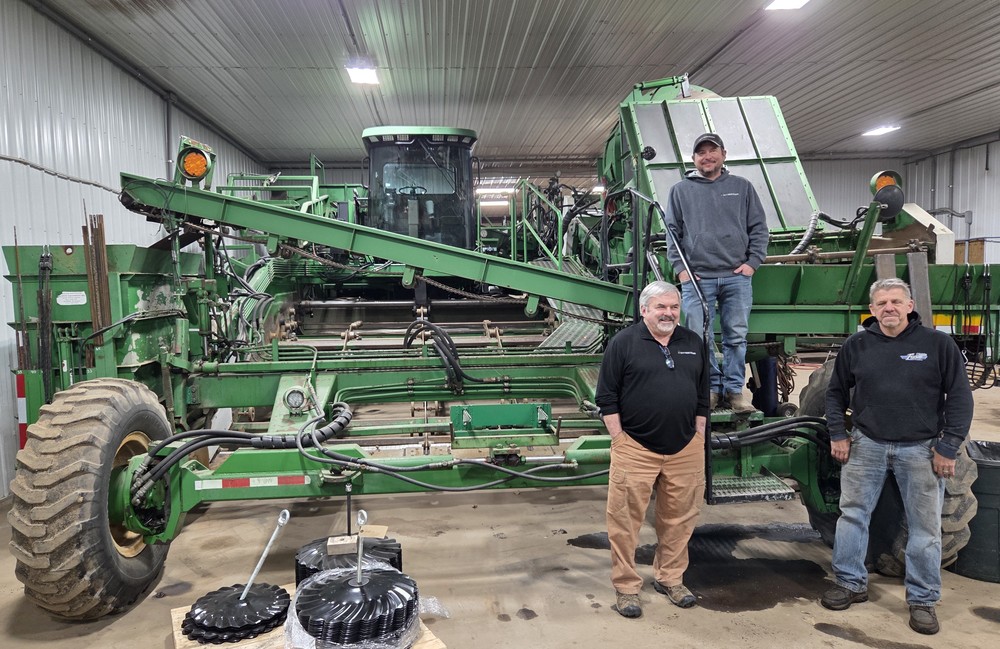 Dennis Iott, Bryan Fischer and Greg Iott with a harvester.
Iott Farms in Kalkaska grows seed potato for mostly downstate farms that supply potato chip producers. This is one of those years where they’re really glad to be in the chip potato business.
“We’re much steadier, price-wise, than the fresh guys are,” Dennis Iott said. “The fresh guys can do really well in some years, but this year they're just getting killed. It's ugly. So [chip potato growers] don't get to hit that really big year, but they also don't get killed in that really bad year either.”
In a year like this, robust customer relationships are vital.
“There's always a farmer willing to sell for less, but that’s when it comes down to the relationship, the service and the quality,” Kitchen said. "We've dealt with some of these people for over 40 years, and it’s really important to have that very strong relationship with your customers.”
Feeling the pinch
Farming isn’t cheap. While potatoes are much less labor-intensive than certain other crops, it still takes people. Add in the equipment, fertilizer, water, materials – all of which continue to skyrocket in cost – and profits erode in a hurry.
“Around COVID time our inputs probably increased 200 percent just like that. They've rebounded some, but really not much,” Jenkins said. “And that being said the price [paid for potatoes] came up only a little bit.”
“It's a capital-intensive business. We have a lot of equipment and a lot of facilities. And, in real numbers, equipment doubled since COVID,” added Fischer of Iott. “Equipment, buildings, labor, fertilizer – everything's gone through the roof.”
Various pieces of equipment that were already expensive are now ultra expensive. High-end, multi-row harvesters can be $1 million or more, and even the smaller stuff can break the bank.
“Tractors are outrageous these days,” Kitchen said. “We’re just going to run ours until they won’t run anymore.”
Rising costs aren’t always a bad thing, though. Cotton and his team at Elmaple Farm won’t be too upset if continued international turbulence causes an uptick in fuel costs.
“One big advantage – and thank goodness we have that advantage this year – is that we're 2,000 miles closer to the major population centers on the East Coast,” he said. “So we do have a freight dollar advantage, and [higher diesel costs] could make a big difference in the next six weeks.”
Though it’s much less of a worry for fresh potato producers, chip potato growers also hope that America keeps on snackin'.
“If people keep taking weight-loss drugs, they’re going to eat less. We’ll be healthier, but we won’t sell as many snacks,” Iott said. “So there’s some concern there, but we’re still in a really good spot.”
Camaraderie and legacy
There are only a few dozen outfits that combine to produce the state’s tremendous potato crop, so it’s a relatively small community.
“The coolest thing about the Michigan potato industry to me is everybody knows everybody,” Iott said. “The chip guys are very competitive with one another, but everybody's still civil, and we still cooperate on new varieties and research at the university and stuff like that. So it's a really tight group.”
The fresh growers describe their network as one of “friendship more than competition.”
“Last year, Elmaple’s harvester broke a couple days before they were going to be done, and it was going to take them a week to get parts,” Jenkins said. “We had finished up the day prior and I said, ‘You know what, our harvester’s sitting here, come get it and get done.' And there's been years when our combine would break, and they say ‘Hey, we're heading your way and we’ll get you done.'”
There’s also a massive amount of pride among these farmers. Kitchen Farms, now at a whopping 5,000 acres, is the result of four generations of hard work, with the fifth generation already involved.
“Great grandpa started in 1910 with 80 acres just like anyone else,” Kitchen said.
Elmaple Farms (1913, fourth generation) and Jenkins (1893, fifth generation) are the same story.
“I have two sons, one's 21 and one's 18, and at this point in time it's looking like they both kind of want to stick around, and they'd be the sixth generation,” Troy Jenkins said. “And I think that'd be really cool if we can pull that off.”
Cotton at Elmaple referenced data that showed that only four percent of farms make it to the fourth generation, and less than one percent make it to the fifth.
“I think we’re pretty solidly looking at being fifth generation, as long as we don't screw something up in the next 10 years,” he said. “And that's a real point of pride that we're able to go on.”
Pictured above: Don Kitchen