The Planning Pros: Mansfield Land Use Consultants has fingerprints all across the region
April 2026
You can’t drive around town without seeing a project touched in one way or another (and in many cases, completely envisioned) by Mansfield Land Use Consultants.
Bonobo Winery and Mari Vineyards. The BATA transfer station and West Shore Bank’s snazzy new office on Eighth Street. The Traverse City Horse Shows campus and Wuerfel Park. Farm Club and Kingsley Club. Crystal Mountain and Crystal Downs. Annika Place and Alexandra Inn. Countless residential projects. The list goes on.
It’s a point of pride for Doug Mansfield, who co-founded the company in 1999 and with his team grew it into one of the most respected – and hired – planning and civil engineering firms in northern Michigan.
“It’s amazing,” he said. “You get to drive by it with your kids and your parents and say, 'We were a part of this, we were a part of that.' It’s a great feeling. And not only did we do it, we did it well.”
The TCBN sat down with Mansfield and fellow managing partner John Hughes to learn more about what sets their company apart.
Face of the project
Mansfield, who grew up in Grayling, spent time working for firms in Metro Detroit before returning north to work at Gourdie Fraser. While he was happy with his work there, he identified a business opportunity: A firm that specialized in representing private clients instead of working in both the public and private sectors.
“A lot of the engineering firms at the time were doing both municipal work and private work,” he said. “I wanted to have a staff that really understood the private sector. Milestones, dates, interest rates, politics, all of these things.”
So began Mansfield Land Use Consultants, which offered a clear value proposition: "Aside from delivering on the many technical aspects of planning and civil engineering – surveys, wetland delineations, road placements and so much more – we understand your desires and constraints. And perhaps most importantly, we know how to work with municipalities and the public to get your projects approved."
That last part is where Mansfield has made a very strong name for itself. Aside from knowing how to cross every T and dot every I from an approval perspective, their team usually handles the often-contentious public input process.
“We’re often the face of these projects,” Mansfield said. “And what we do gets a lot of publicity – good, bad and ugly. There’s a lot of scrutiny.”
And rightfully so. There are emotions that come with change of any kind, especially when it comes to projects that will be near people’s homes.
“There's no one more tense or more nervous than someone defending their backyard. I mean, you're going to have an impact on their life,” he said. “And things get unruly, sometimes personal. We've had our challenges when you walk out into a hostile crowd and things like that.”
It’s not for everyone. There are firms that stay away from handling public approval processes because they don’t want their names tied to something controversial, Mansfield says, and there are people who just can’t handle the pressure cooker formed by a room full of agitated neighbors.
“You have to know that it’s not directed at you and get good at letting it go. And a lot of people can't do that. We've gone through people that said, 'I don't want to be the bad person.’ Well, you're not. You're just carrying the message,” Mansfield said.
Mansfield understands all of these dynamics very well. He’s been the supervisor of Grand Traverse County’s Union Township for more than 30 years, and he’s seen things from the other side. That’s something his firm always tries to stress: We live here too.
“We are the face for the big bad developer. We recognize that. What we do is not always, in the eyes of people who've been here forever, the greatest deal,” he said. “But we also live here. We make sure people know we live here. What we do is also going to impact us.”
The Mansfield team also makes a genuine effort to alter plans based on public suggestions, where possible.
“It gets better as people provide input … and sometimes it's the littlest thing: a trail, a piece of woodlands, something where somebody has a memory or a view, all of these kinds of things. Sometimes it's moving things 10 feet, 30 feet,” he said. “And generally, we listen … we can make it better.”
All of this is not to say Mansfield is only handling contentious developments. The firm has been a part of dozens of projects for nonprofits and various community agencies that enjoy broad public support.
“As much as we work on the top of the line in this market, we work with Habitat [for Humanity - Grand Traverse Region] and HomeStretch [Nonprofit Housing] and those kinds of things too,” he said. “We’ve walked some of the most beautiful pieces of land the [Grand Traverse Regional Land] Conservancy has been a part of.”
Experience and responsiveness
While tremendously valuable, Mansfield’s ability to navigate the pitfalls of the public approval process is just one reason clients appreciate this firm.
Mansfield says his firm has long prided itself on being very accessible and responsive to its clients, something they very much appreciate in the fast-paced world of development.
“Things can happen in an instant that affect these projects,” he said. “So some people will say, ‘Maybe you’re not the biggest or best in the nation, but you pick up the phone almost every time I call.’ And that's a hard thing to get these days.”
This responsiveness is particularly important in a day and age when the real estate market remains white hot.
“If you see a piece of land in Traverse City, how long do you have before it's picked up? Not a lot of time,” Mansfield said. “So we are extremely responsive to those first due diligence questions: ‘Should I wrap this thing up? Should I take an option?’ They need to know in hours, not weeks. So we make that happen extremely quickly.”
Mansfield is also proud of his firm’s continued hard work to make projects pencil out for their clients, something that gets harder and harder as costs continue to rise across the board.
“To make the dollars and cents of this work can be really, really tough,” he said.
Last but certainly not least, Mansfield and Hughes are tremendously proud of their staff, who make everything happen.
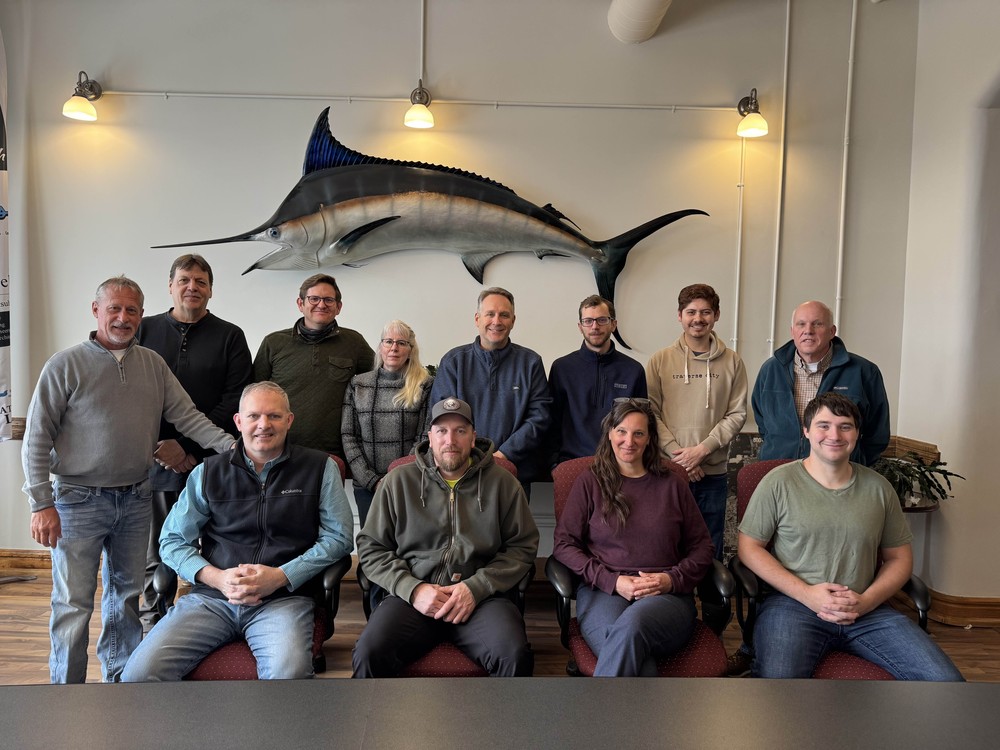 Some members of the Mansfield staff.
“At the heart of our story is a team defined by unwavering dedication and refined professionalism,” Hughes said. “By blending their unique strengths and pushing through every challenge together, they are the hands and minds that consistently bring our most ambitious goals to reality.”
“Any success the firm has enjoyed is most certainly due to the commitment and professionalism of our staff,” Mansfield added. “Our partners will repeatedly say, 'They are the best at what they do,’ and we firmly believe that.”
Mansfield’s diverse team of “artists and authors, geniuses, jocks and farmers” has a way of producing far more than the sum of its parts, Mansfield says.
“In this group you will find complimentary and conflicting ideals that, when challenged, will create this odd energy that only proves to make each project better,” he said.
Ultimately, the ability to quite literally shape the landscape for generations to come is a very enjoyable part of this business that keeps this staff engaged and involved.
“I'm designing beautiful places. It's just not a sewer in the ground or a paved road that some state or federal agency has given me the guidelines for. I'm deciding how this road's going to curve and what trees are going to be saved and what you're going to feel going up and down, and what the views are,” Mansfield said. “And when you go back and drive it, [it’s an incredible feeling], and I think that's why people embrace this field, and that's why they've stayed here.”
Mansfield carries with him all sorts of fun memories of projects past. An example: A tunnel to the wine caves at Mari Vineyards is situated in just such a way to ensure it aligns perfectly with the sun on the summer solstice.
“So when [Mari owner] Marty [Lagina] opened the doors of the caves to the solstice on that first year, and the sun came right down that tube, that was our surveyors that worked with him to ensure that that happened,” Mansfield said. “And that’s what makes projects neat, when you do those little things.”
‘I don’t see a downturn’
Mansfield’s firm has been around long enough to remember the major bumps in the road. The Sept. 11 terrorist attacks, COVID-19, various major conflicts and other happenings put a serious hurt on development activities. All of those aforementioned incidents pale, he says, in comparison to the major 2008 downturn.
“As much as they think about COVID and 9/11, that recession was probably one of the biggest game changers,” he said. “We were sitting there just wondering where our next project was going to come from … and you just never thought it was going to last that long.”
Those wonders are long gone. Development has surged in the post-COVID world, even with inflation and high land prices.
“Since being labeled the most beautiful place in the world, and COVID showing what you could do here with remote workers … people are saying, ‘How did you hide this place?’” Mansfield said.
While density still makes sense for a lot of projects, Mansfield says, a lasting legacy is that many projects are laid out a little differently these days.
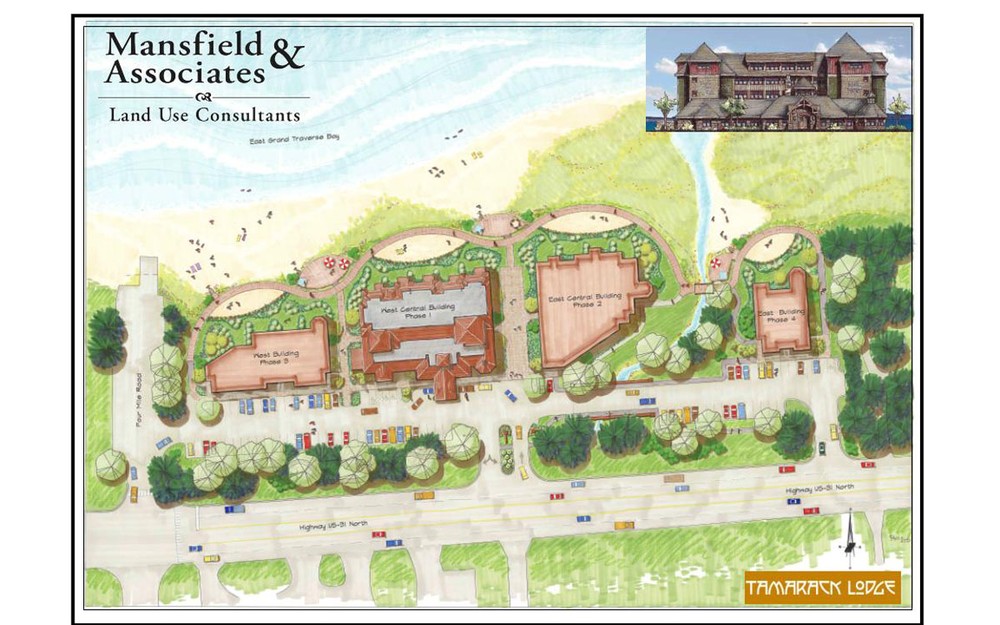
“It's kind of a less is more thing again. People like their space now after COVID,” he said. “So it’s changed from that jam everything in we could [mentality] to people wanting their elbow room.”
So too has the type of land being developed, particularly for residential, though this is more a function of what land is actually left to develop. Gone is the waterfront, for example, so the next best thing are those high ridgelines.
“We're on to the next tiers of land, so to speak. Now we're talking about finding the best parcels for the off-water views,” Mansfield said. “And where are the roads that are available for developments, since utilities are starting to get stretched? With corporate utilities, it's hard to get them to go further [to make things happen].”
The Mansfield team expects to see continued growth throughout the region.
“All the way up to Mackinac, that northwest corridor, anything is viable. And [there are] reasonable prices,” he said. “I don’t see a downturn. The stuff we see isn’t based on, ‘What will the bank lend us?’ It's based on materials and labor and the reality of developing things in this region.”
Mansfield is also excited to be a part of land use solutions going forward.
“With the tree crops suffering, we're working with the farmers on Old Mission and to look at some of these agritourism concepts,” he said. “How do we sustain these farms and keep them going? And where is farming going now?”